Mastering the Grain: The Physics of Texture in Modern Rice Cooking
Update on Feb. 6, 2026, 12:18 p.m.
Cooking rice is often perceived as a mundane task, a simple equation of water plus grain plus heat. Yet, for the culinarily curious, it is a complex thermodynamic event. The difference between a bowl of mush and distinct, aromatic grains lies not just in the ratio of water, but in the precise manipulation of pressure and heat delivery. Advanced kitchen technology has moved beyond simple boiling, introducing variables that allow home cooks to engineer the very structure of their food.
The Dual Nature of Pressure: Controlling Gelatinization
At the molecular level, cooking rice is the process of starch gelatinization. Granules of amylose and amylopectin absorb water and swell when heated. The environment in which this happens dictates the final texture. This is where the concept of a twin pressure rice cooker becomes revolutionary. It offers a choice that fundamentally alters the cooking physics: high pressure versus atmospheric pressure.
Under high pressure (typically exceeding 1.8 atmospheres), the boiling point of water rises significantly above 100°C (212°F). This superheated moisture penetrates the tough outer layers of short-grain rice varieties rapidly. The intense energy forces the starch granules to burst and fuse, creating the desirable “stickiness” and chewiness characteristic of Korean and Japanese cuisine. It is not just cooking; it is a forced textural transformation.
Conversely, cooking without pressure allows water to boil at standard atmospheric temperatures. The agitation is gentler, and the steam is less aggressive. This method preserves the integrity of long-grain varieties like Basmati or Jasmine, encouraging the amylose structures to remain linear rather than tangling. The result is a fluffy, aerated bed of grains where each kernel stands distinct from its neighbor.

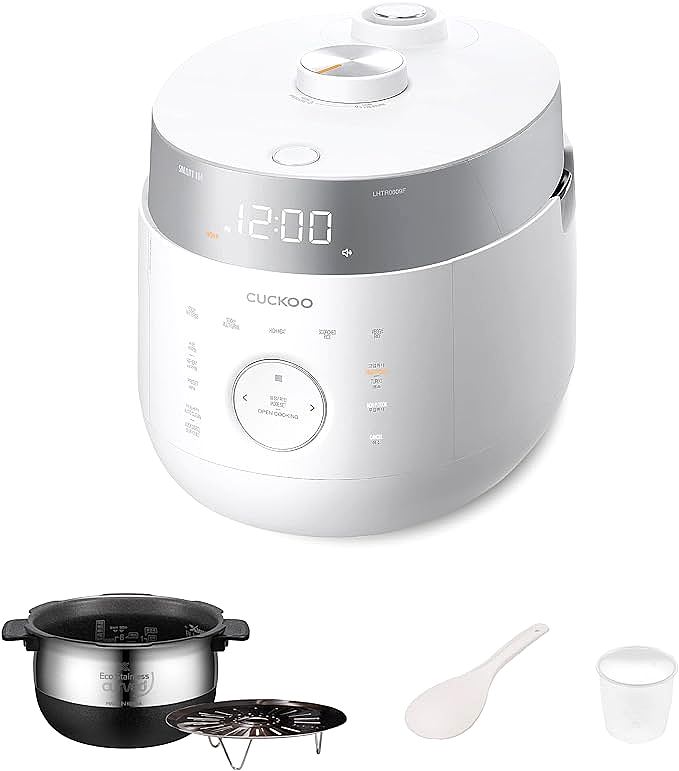
The CUCKOO CRP-LHTR1009F exemplifies this duality. By engineering a valve system that can seal for high-pressure situations or vent for non-pressure cooking, it provides a physical toggle between two distinct culinary worlds. One setting creates the dense, sweet stickiness required for sushi; the other yields the light, separate grains perfect for a pilaf or bibimbap base.
Induction Heating: The End of Thermal Gradients
Traditional heating elements, located at the bottom of a pot, rely on conduction to transfer energy. This often creates a thermal gradient—hot at the bottom, cooler at the top—leading to the dreaded crust of burnt rice or an unevenly cooked batch.
Induction heating (IH) changes the vessel itself into the heat source. Through electromagnetic fields, coils in the base induce electrical eddy currents within the metal of the pot. Electrical resistance converts these currents into heat instantly and uniformly across the entire surface of the vessel.
This technology ensures that a grain of rice floating at the top receives the same thermal energy as one resting at the bottom. The 60-degree curved bottom of the CUCKOO’s inner pot further optimizes this by promoting vigorous convection currents. These currents circulate water and grain, ensuring that every starch granule is exposed to equal heat and hydration. The result is a consistency that manual stovetop methods struggle to replicate.
Material Science and Purity
The vessel in which these reactions occur is as critical as the heat source. Reactive metals can leach flavors or chemicals, altering the delicate profile of premium grains. 304 food-grade stainless steel is the standard for a reason. Its alloy composition, rich in chromium and nickel, forms a passive oxide layer that resists corrosion from the acidic and alkaline byproducts of cooking.

However, stainless steel is notoriously prone to sticking. The integration of advanced non-stick technologies, such as the X-Wall coating found in the CRP-LHTR1009F, bridges the gap between hygiene and utility. It allows the user to benefit from the thermal mass and safety of steel without the frustration of food adhering to the surface, a crucial factor when dealing with the sticky starches of high-pressure cooking.
The Biochemistry of GABA Rice
Beyond texture, modern appliances are beginning to unlock nutritional potential. Brown rice contains gamma-aminobutyric acid (GABA), a neurotransmitter linked to relaxation and stress reduction. However, it is largely locked away in the dormant germ of the grain.
To access it, the grain must be “activated” through a precise soaking and heating process that mimics germination. This enzymatic activity converts glutamic acid into GABA. Specialized algorithms in advanced cookers can hold the rice at the exact warm temperature required to stimulate this bio-conversion before the actual cooking cycle begins. It transforms a side dish into a functional food, enhancing its nutritional profile through the application of precise thermal control.
Understanding these principles—pressure dynamics, electromagnetic heating, and enzymatic activation—shifts the perspective on what a kitchen appliance can do. It is no longer just about heating water; it is about mastering the physics of the grain to achieve a specific, repeatable, and culinarily superior result.