Presto Nomad Traveling Slow Cooker: Slow Cooking on the Go
Update on Sept. 17, 2025, 9:25 a.m.
Your slow cooker is a secret masterclass in engineering. Here’s how it conquers gravity, heat, and motion.
It’s a scenario played out in kitchens everywhere. You’ve spent hours crafting the perfect chili, a molten masterpiece of flavor destined for a friend’s party. The final step? Transporting it. You place the searingly hot, sloshing ceramic pot into a cardboard box, cushioned by a nest of old towels. You drive like you’re transporting nitroglycerin, wincing at every pothole, taking corners at a glacial pace, praying that the precariously balanced lid doesn’t betray you.
Transporting hot, heavy, liquid-filled containers is a quiet domestic nightmare. It’s a battle against sloshing, spilling, and tipping—a battle, fundamentally, against the laws of physics.
Most of us just accept this struggle as part of the deal. But engineers, bless their hearts, look at a problem like this and see an opportunity. They see a system ripe for a redesign. And by dissecting one of the elegant solutions to this problem—a modern traveling slow cooker—we can uncover a fascinating masterclass in the everyday application of physics, material science, and brilliant, uncompromising design.

The War Against Gravity: Conquering the Tip-Over
The first and most immediate threat during food transport is the tip-over. A traditional slow cooker, tall and oval, has a high center of gravity. It’s like a double-decker bus trying to navigate a racetrack— inherently unstable.
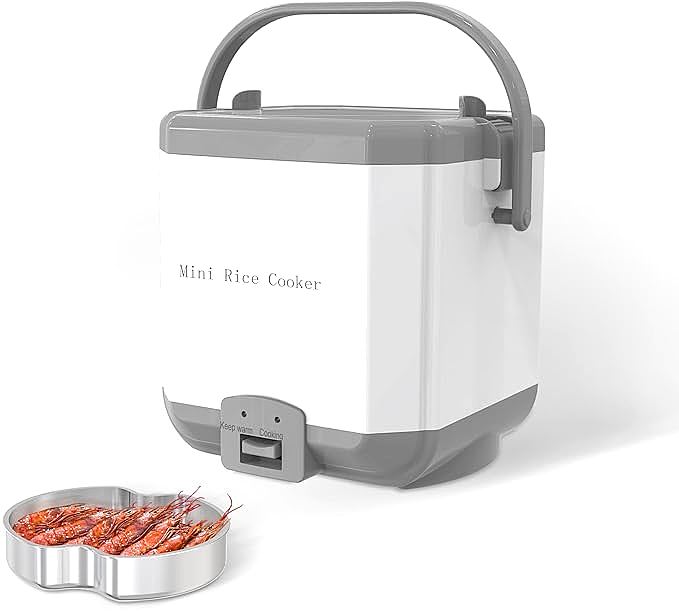
The solution seems obvious in retrospect: make it short and wide. Many traveling cookers adopt a “picnic cooler” form factor, looking more like a toolbox than a piece of kitchenware. This isn’t an aesthetic choice; it’s a direct strategic assault on the physics of instability.
Every object has a “center of gravity,” a theoretical point where its entire weight is concentrated. The lower this point is to the ground, the more stable the object. Think of a Formula 1 race car, practically scraping the asphalt. Its incredibly low center of gravity is what allows it to take sharp turns at ludicrous speeds without flipping.
But a low center of gravity is only half the equation. The other half is the “base of support”—the area enclosed by the points where the object touches the ground. A wider base provides a much larger margin for error before the center of gravity moves outside of it, causing a tip. It’s the difference between trying to stand on one leg and standing with your feet planted wide apart.
The designers of this traveling cooker understood this principle intimately. By making the device wide and low, they simultaneously lowered its center of gravity and expanded its base of support. The result is an object that is fundamentally, physically, resistant to tipping. It’s a quiet declaration of victory over one of the most basic forces that governs our world.

The Great Escape: Taming the Slosh
Even if you prevent a tip-over, you still have to contend with the chaotic energy of the liquid inside. With every bump and turn, waves of hot chili crash against the lid, searching for the tiniest gap to exploit. A standard lid, resting loosely by its own weight, is no match for this.
The solution is a system of mechanical clamps and a flexible gasket. This isn’t just a lid; it’s an engineered seal. When you swing the handle upright on a model like the Presto Nomad, it acts as a lever, engaging clamps that pull the lid down with significant force. This force is the key.
It’s not being applied to a hard plastic-on-plastic edge. Instead, it’s pressing the lid into a soft, silicone gasket. This is the same principle that seals a submarine hatch or a canning jar. Under pressure, the flexible gasket material deforms, filling every microscopic imperfection between the lid and the pot’s rim. It creates a continuous, unbroken barrier that liquid, even under the pressure of a powerful slosh, simply cannot breach. It’s a beautiful example of using mechanical force and material properties to create a perfect, contained environment.

The Art of the Deal: A Material Science Trade-Off
Here’s where the design philosophy gets really interesting. For decades, the heart of a slow cooker has been its ceramic crock. Ceramic is fantastic at retaining heat—it has a high thermal mass, meaning it absorbs a lot of energy and releases it slowly. But it has two major drawbacks: it’s incredibly heavy and notoriously brittle.
For a device designed to travel, heavy and brittle are two of the worst possible attributes.
So, the engineers made a deliberate trade-off. They replaced the heavy ceramic with a thin, lightweight aluminum pot. From a purely scientific standpoint, this is a fascinating compromise.
- Ceramic: High heat capacity (holds heat well), low thermal conductivity (heats up slowly), high density (heavy), brittle (shatters).
- Aluminum: Low heat capacity (loses heat faster), high thermal conductivity (heats up quickly), low density (light), ductile (dents instead of shatters).
Engineers often use conceptual tools like Ashby charts to visualize these properties and make choices. They knew that for a portable device, shedding pounds was the top priority. The user needed to be able to carry it from the car to the picnic table without strain. So they sacrificed the superior heat retention of ceramic for the lightweight, durable nature of aluminum. This choice reveals the soul of the product. It’s not meant to be the absolute best insulator; it’s meant to be the best traveling cooker. Every engineering project is a story of such compromises, a delicate balance of competing priorities to create the best possible solution for a specific problem.

Controlling the Flow: The Thermodynamics of a Warm Meal
Having chosen a metal pot that heats up and cools down faster, the engineers now faced a new problem: how to keep the food warm for hours while ensuring the outside of the device is safe to touch. The answer lies in thermodynamics, specifically in thwarting the three ways heat tries to escape.
Heat transfer happens in three forms: conduction (through direct contact), convection (through the movement of fluids like air), and radiation (through electromagnetic waves). A truly effective insulator has to fight all three.
The traveling cooker’s body is essentially a fortress against this escape. It’s a double-walled system, much like a high-end thermos or a double-pane window.
The hot inner pot is separated from the cool outer plastic shell by a gap of air. This air gap is a terrible conductor of heat, dramatically reducing heat loss through conduction. Since the air is trapped, it also can’t form currents, which stifles heat transfer by convection. Finally, the materials themselves are chosen to minimize radiation.
This elegant system achieves two goals at once. It keeps the heat where you want it—in the food—for longer, partially compensating for the lower thermal mass of the aluminum pot. And it keeps the exterior “cool-touch,” a critical safety feature that prevents accidental burns during transport.

The Genius in the Mundane
From the outside, a traveling slow cooker might look like a simple, perhaps even slightly clumsy, kitchen appliance. But the moment you look at it through the lens of a physicist or an engineer, it transforms. You no longer see a plastic box; you see a calculated solution to the force of gravity. You no longer see a simple lid; you see a sophisticated sealing system battling fluid dynamics. You see a story of deliberate material science trade-offs and a clever thermodynamic design.
This level of hidden genius exists in countless objects we use every day without a second thought—a can opener, a stapler, a thermos. They are the quiet triumphs of human ingenuity, the physical embodiment of scientific principles applied to solve utterly mundane, yet deeply relatable, problems.

The next time you pick up a simple tool that just works, take a second. Appreciate the invisible engineering, the silent physics, and the thoughtful compromises that had to happen for that object to exist in your hands, making your life just a little bit easier. You’re holding a solution to a problem you may have never even realized you had.