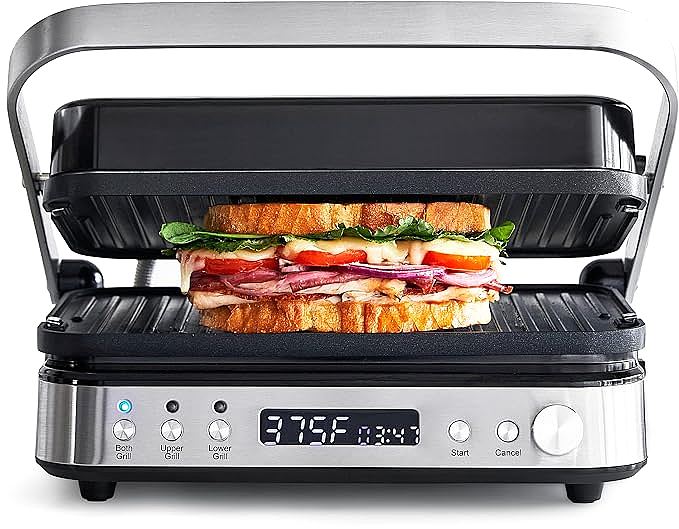
The Thermodynamics of Social Cooking: Analyzing Diamond-Infused Ceramics in the GreenPan 3-in-1 Grill
Update on Nov. 25, 2025, 10:08 a.m.
In the cookware industry, “nonstick” has traditionally been synonymous with fluoropolymers (PTFE). However, the physics of cooking is undergoing a material revolution. The GreenPan 3-in-1 Electrics Healthy Ceramic Nonstick represents the forefront of this shift, utilizing Inorganic Sol-Gel Chemistry to replace synthetic plastics.
But this appliance is more than a health statement; it is a study in Thermal Engineering. By incorporating Diamond Crystals into its matrix and designing a dual-layer heat topology (Grill + Raclette), it solves the historical conductivity problems of ceramic coatings while creating a unique social cooking platform.

Material Science: The Physics of “Thermolon Volt”
Ceramic coatings are derived from sand (silica), creating a glass-like surface. Historically, ceramics are thermal insulators. GreenPan solves this with Thermolon Volt, a specialized coating for electrics.
Diamond Infusion: Phonon Conduction
The inclusion of diamonds is an engineering decision, not a luxury one.
* Thermal Conductivity: Diamond has the highest thermal conductivity of any bulk material ($\approx 2200 W/m\cdot K$), roughly 5 times that of copper.
* The Lattice Effect: By embedding diamond crystals in the ceramic matrix, GreenPan creates high-speed thermal pathways. This allows the 350W element’s energy to spread rapidly across the cooking surface, eliminating the “hot spots” and “cold corners” typical of standard ceramic pans.
* Durability: Diamonds also increase the Vickers Hardness of the coating, making it resistant to the thermal expansion/contraction cycles of an electric grill.
Sol-Gel Chemistry: The Anti-Plastic
Unlike PTFE, which is a long-chain polymer, Thermolon is formed via the Sol-Gel Process. This creates a chemically inert, inorganic network.
* Thermal Stability: It does not degrade or release fumes (like PFOA/PFAS) even if accidentally overheated beyond 500°F, providing a safety margin that plastics cannot offer.

Structural Thermodynamics: The Reversible Cast Aluminum Plate
The core chassis is Cast Aluminum. In thermal physics, aluminum is the ideal balance of Specific Heat Capacity and Conductivity.
* Thermal Mass: The heavy cast plate acts as a heat capacitor. It stores energy to sear a steak without the temperature plummeting, yet responds quickly enough to adjustment dials.
* Reversible Topology:
* Grill Side: Ridges reduce the contact area, increasing the Local Pressure on the meat for defined sear marks (Maillard Reaction) while allowing fat to drain.
* Griddle Side: Maximizes surface contact for eggs and pancakes, utilizing the uniform heat distribution of the diamond matrix.

The Physics of Raclette: Dual-Layer Heating
The “3-in-1” designation includes a Raclette function. This introduces a second thermodynamic zone.
* Radiant Heating: The 8 mini pans sit below the heating element. Here, heat transfer is primarily Radiative. This gentle, top-down infrared heat is perfect for melting cheese (changing its phase from solid to viscous liquid) without burning the bottom.
* Simultaneous Processing: The system allows for high-heat conduction cooking on top (searing meat/veg) while simultaneously performing low-heat radiative melting below. This Thermal Cascading maximizes the utility of the single heating element.

Conclusion: The Engineer’s Dinner Party
The GreenPan 3-in-1 is a device where Material Science meets Social Engineering. By solving the conductivity limits of ceramic with diamonds and designing a chassis that utilizes both conductive and radiative heat, it offers a PFAS-free cooking experience that doesn’t compromise on performance. It transforms the table into a dynamic thermal environment, safe for both the food and the diners.