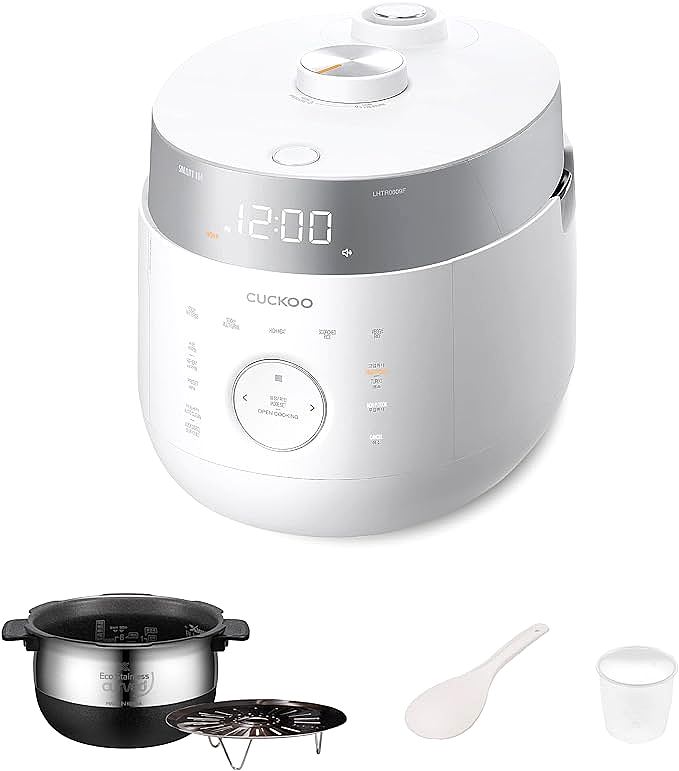
The "Small Pot Problem": Why Fuzzy Logic is Essential for a 2L Rice Cooker
Update on Nov. 13, 2025, 2:21 p.m.
It’s a culinary paradox: cooking a small amount of rice is often more difficult than cooking a large batch. Anyone who has tried to make just one or two servings on a stovetop knows the frustration. You’re left walking a fine line between a gummy, undercooked center and a scorched, burnt bottom.
This isn’t a failure of your cooking skills; it’s a failure to account for physics. And it’s this precise challenge—the “Small Pot Problem”—that separates basic small appliances from truly intelligent ones.
The “Small Pot Problem”: A Challenge of Physics
When you scale down a recipe, the physics don’t scale down linearly. Cooking rice is a game of heat and hydration, and in a small pot, the rules change dramatically.
- Low Thermal Mass: A large, 10-cup cooker with several liters of water and rice has high thermal mass. It acts like a buffer, absorbing and distributing heat slowly and evenly. A small 2-liter pot has almost no buffer. It heats up and loses heat incredibly fast.
- Intense, Direct Heat: A 350-watt heating element in a compact 2L body is proportionally powerful. The heat is direct and intense, concentrated on a small surface area at the bottom.
- Rapid Evaporation: The water-to-surface-area ratio is different. Water can evaporate more quickly relative to the total volume, throwing off the delicate rice-to-water ratio required for perfect absorption.
In this unforgiving environment, a simple “on/off” thermostat—the kind found in basic, old-school cookers—is a recipe for disaster. It boils the water, waits for a temperature spike (when the water is gone), and shuts off. It has no nuance, no adaptability. The result is inconsistency, the very problem that automated cookers were meant to solve.
Fuzzy Logic: The Necessary “Brain” for Small-Batch Precision
This is where “Fuzzy Logic” or “Micom” (microcomputer) technology transitions from a luxury marketing term to an essential engineering solution.
“Fuzzy Logic” is simply a way for a machine to handle “in-between” states. Instead of just “On” (boiling) or “Off” (done), it operates on a spectrum, using a sensor (a thermistor) as its “finger” to constantly monitor the pot’s internal temperature.
This Micom “brain” runs a dynamic feedback loop:
1. Sense: It feels the current temperature.
2. Analyze: It compares this temperature to a pre-programmed ideal heating curve (the “perfect” way to cook rice).
3. Adjust: It makes millisecond adjustments to the 350W heating element, pulsing the power, raising it, or lowering it to perfectly track that curve.
In a large cooker, this system is helpful. In a small 2L cooker, it is critical. It’s the only thing that can manage the intense heat and low buffer, ensuring the rice is gently “coaxed” through its cooking phases—soaking, heating, boiling, absorbing, and steaming—without the process failing at the first hurdle.

A Case Study: Deconstructing the Bear DFB-B20K1
A perfect example of this philosophy in practice is the Bear DFB-B20K1. At first glance, it’s a compact, 2-liter (8-cup cooked) appliance, sized specifically for the 1-4 person households that face the “Small Pot Problem” daily. But its design centers entirely on solving it with technology.
The 6-Function Brain
The cooker’s six functions (“White Rice,” “Brown Rice,” “Porridge,” “Soup,” “Cake,” “Reheat”) are not just six different timers. They are six unique heating curves stored in its Micom.
- The “Brown Rice” algorithm knows it needs a longer, gentler soak and a more patient cooking cycle to get through the tough bran.
- The “White Rice” function is optimized for a faster, higher-heat absorption.
- The “Cake” function proves the system’s precision: it can hold a temperature low and stable enough to bake, not just boil.
This multi-functionality is a direct result of the precise temperature control afforded by its fuzzy logic.

The Inevitable Trade-Offs: Precision vs. Speed
This precision-first approach necessitates certain trade-offs, which are often misinterpreted as flaws.
1. The “Speed” Trade-Off:
Some feedback notes a 50-minute cook time for white rice, which seems long compared to a 15-minute stovetop boil. This is not a bug; it’s a feature.
That 50-minute cycle isn’t just 50 minutes of boiling. It includes:
* A “sensing” and “soaking” phase at low heat.
* A controlled, gradual ramp-up to boiling temperature.
* A “simmering” or “absorption” phase with pulsed power.
* A final “steaming” or “resting” phase after the main heat is off.
The 15-minute stovetop method is just brute-force boiling. The 50-minute fuzzy logic cycle is an automated, perfect, start-to-finish process. The value you gain is not speed; it’s consistency and the ability to walk away.
2. The “Keep Warm” Trade-Off:
Other feedback notes that after very long “Keep Warm” periods (approaching 24 hours), a slight, crisp layer of rice (or tahdig) can form at the very bottom. This is, again, simple physics. A bottom-mounted heater that must keep the entire pot food-safe and warm will inevitably, over a long enough period, dehydrate the bottom-most layer it’s in direct contact with.
This is a universal trade-off for all bottom-heated warmers. The fact that users report the rest of the rice stays “phenomenally” moist and not dried out (even after 24 hours) is the real testament to the “Keep Warm” function’s intelligent, low-power management.

The Final Grain: Why Technology is the Answer
Cooking for one or two shouldn’t mean compromising on quality. But the physics of small-batch cooking are stacked against you. In this context, smart technology like Fuzzy Logic isn’t a gimmick. It is the core engineering solution that makes consistent, high-quality results possible in a compact form.
Appliances like the Bear DFB-B20K1 demonstrate a clear understanding of this problem. By integrating a “Micom” brain, a 24-hour timer, and a high-quality, non-stick (and BPA-free) pot, it’s designed from the ground up to be a “set it and forget it” solution. It addresses the “Small Pot Problem” head-on, freeing up your stovetop and, more importantly, your mental energy, delivering a perfect foundation for a meal, every time.