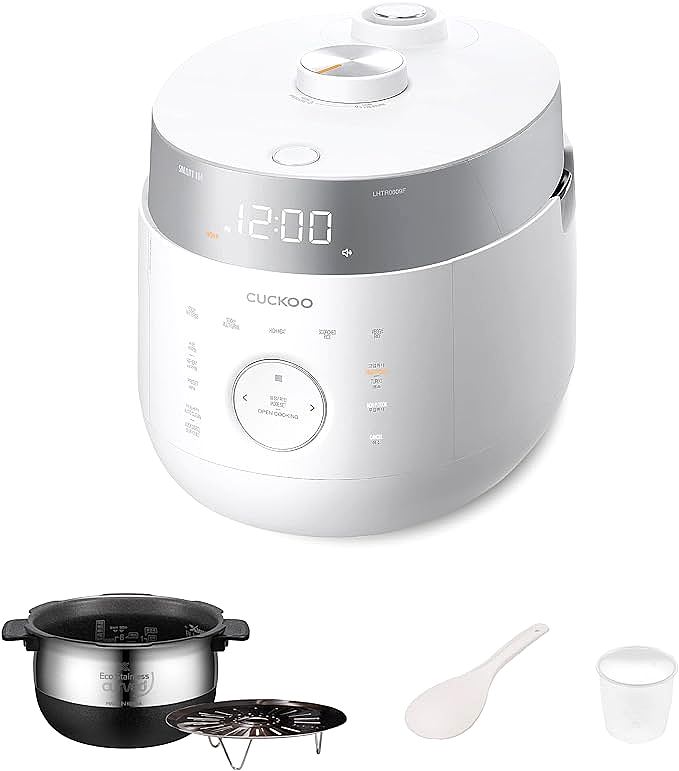
The Physics of the dorm: Managing Heat and Foam in the Bear Mini Rice Cooker
Update on Nov. 25, 2025, 10:30 a.m.
In the hierarchy of kitchen engineering, the Bear DFB-B12W1 Mini Rice Cooker represents the principle of Minimalist Efficiency. Unlike its fuzzy-logic cousins, this device relies on fundamental physics to execute a single task: phase-change cooking.
For the student or traveler, it is a survival tool. But user feedback often highlights a common struggle: The Boil-Over. To master this machine, one must understand the Thermodynamics of 200 Watts and the Fluid Dynamics of Starch Foam.

The Energy Equation: 200W vs. 1.2 Liters
The power rating of 200 Watts is specific. It is the Critical Energy Threshold required to maintain a rolling boil for 1.2 liters of water/rice mixture without excessive energy waste.
* Heat Flux: The heating element transfers energy to the pot via conduction. Because the pot is small, the Surface-Area-to-Volume Ratio is high, allowing for rapid heat loss. The 200W input balances this loss to sustain the Latent Heat of Vaporization needed to steam the rice.
* Efficiency: This low wattage means the device can run on limited power sources (like RV inverters), making it a true portable solution.
The Physics of the “Spurt”: Starch Foam Dynamics
Users frequently complain about water spurting from the vent. This is not a machine defect; it is Starch Chemistry.
As rice boils, starch granules rupture, releasing Amylose into the water. This increases the viscosity of the liquid and strengthens the surface tension of bubbles.
* The Foam Column: In a small vessel, this starch foam rises rapidly. If the headspace is insufficient (overfilling), the foam enters the steam vent.
* The Physics Hack: To prevent this, introduce a Lipid (Fat). Adding a teaspoon of oil disrupts the protein/starch matrix of the bubble walls, causing the foam to collapse. This simple chemical intervention solves the mechanical problem of overflow.

Control Logic: The NTC Switch
How does a one-button machine know when to stop? It uses a Magnetic Thermostat or NTC Thermistor.
* The Phase Change Signal: While water remains in the pot, the temperature cannot exceed 212°F (100°C). Once the water is absorbed or boiled off, the temperature of the pot bottom spikes past 212°F.
* The Trip: The sensor detects this rapid rise (thermal runaway) and physically trips the switch from “Cook” to “Warm.” This is a reliable, physics-based control mechanism that requires no complex software.

Material Safety: PFOA-Free Thermodynamics
The inner pot uses a Non-Stick Coating. In a low-wattage device, the risk of overheating the coating (which occurs >500°F) is minimal during normal use because the water acts as a thermal buffer. However, the “PFOA-Free” certification is crucial for chemical safety, ensuring no persistent organic pollutants migrate into the food even if the pot runs dry for a short period before the sensor trips.
Conclusion: The Physics of Simplicity
The Bear Mini Rice Cooker is a lesson in Appropriate Technology. It solves the problem of cooking grain through the most direct application of heat and physics. By understanding the behavior of starch foam and the logic of thermal sensors, users can transform this simple tool into a precision instrument for the solo kitchen.