The $40 Steamer: Decoding the Trade-Offs of 800W vs. 13.7QT Capacity
Update on Nov. 12, 2025, 7:03 p.m.
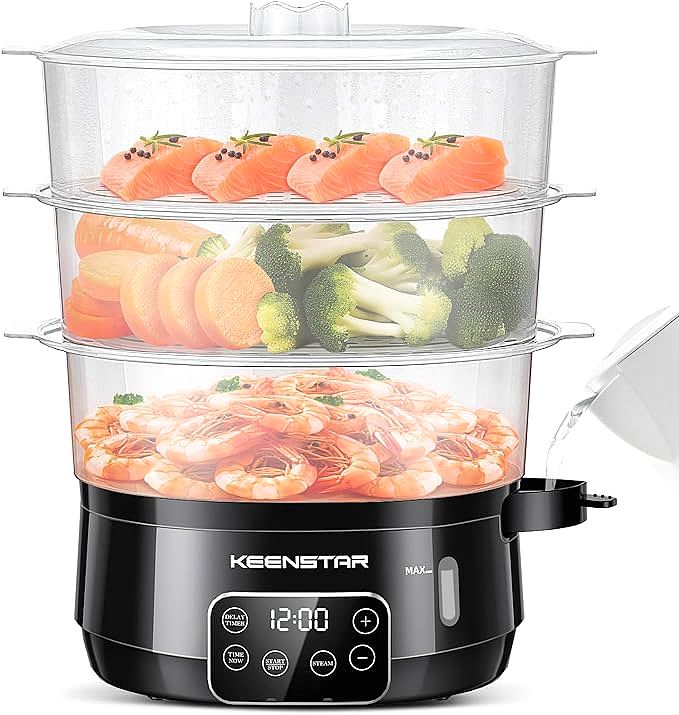
In the world of kitchen appliances, the $40 price tag is a powerful signal. When applied to a device with a massive 13.7-quart capacity, like the KEENSTAR MK902-US Electric Food Steamer, it presents an immediate engineering question: where are the compromises?
Marketers may use terms like “800W turbo-steam” and “fast cooking,” but the laws of thermodynamics are inflexible. A $40, 13.7-quart, 800-watt appliance is not a high-performance machine. It is a high-convenience machine.
Understanding its design not as a “fast” cooker, but as a “set-it-and-forget-it” tool, is the key to appreciating its true value. This isn’t a review; it’s a “first principles” deconstruction of the budget electric steamer.
The Power-to-Volume Mismatch: 800W vs. 13.7QT
The most significant trade-off is performance. Let’s be clear: 800 watts is a relatively low amount of power. It’s the equivalent of a small two-slice toaster.
The task of this 800W element is to boil water and then generate enough sustained steam to fill a 13.7-quart (13-liter) chamber—and not just fill it, but maintain a 212°F (100°C) cooking temperature across three separate tiers.
This is thermodynamically slow. It will take time to build up that initial volume of steam. Therefore, the “turbo-steam” claim is a marketing term for “it eventually makes steam.”
The real value of this 800W motor is not speed; it’s efficiency and convenience. It’s a low-energy-draw appliance that you can fill, set the 60-minute timer on, and walk away from. It’s designed for the person who wants to “set-it-and-forget-it” while they do something else. You are trading your time for the appliance’s low cost and autonomy.

The Stacking Paradox: Storage vs. Cooking Physics
The 3-tier, stackable design is the second major trade-off. This is a brilliant feature for storage, allowing the 13.7QT unit to nest into a compact footprint.
As a cooking design, however, it has inherent physical limitations that you must understand to be successful:
1. Steam Loses Energy: Steam is hottest and most powerful at the bottom, closest to the 800W element.
2. Heat Rises, Energy Drops: As the steam rises through the first tier, it cooks the food but also loses energy (heat). The steam reaching the second tier is cooler and less dense. The steam reaching the top tier is cooler still.
3. The Result: The bottom tier will always cook the fastest. The top tier will always cook the slowest.
This is not a flaw; it is physics. This “uneven” cooking must be managed. The correct way to use a 3-tier steamer is to “stack” your meal strategically:
* Bottom Tier: Dense, long-cooking items (e.g., potatoes, chicken pieces, winter squash).
* Middle Tier: Medium-density items (e.g., broccoli florets, carrots, rice-in-a-bowl).
* Top Tier: Delicate, fast-cooking items (e.g., leafy greens, fish fillets, asparagus).
The Material Compromise: Polypropylene vs. Glass
The third trade-off is the material. To hit a $39.99 price, the baskets are made of BPA-Free Polypropylene (PP).
- The Upside: This is an excellent, safe, and logical choice for a budget appliance. It is lightweight, shatterproof (unlike glass), and the “BPA-Free” status addresses the primary health concern associated with heating plastics.
- The Long-Term Trade-Off: Polypropylene, while safe, is not inert. Over time, it will be affected by your cooking.
- Staining: Highly pigmented foods (e.g., carrots, beets, turmeric) will permanently stain the clear plastic.
- Odor Retention: Aromatic foods (e.g., fish, garlic, broccoli) will leave behind oils and odors that can be difficult to wash out and may “ghost” your next meal.
- Durability: Over years of heat cycles and dishwasher use, the plastic will eventually become cloudy, brittle, and may crack.
A glass or stainless steel steamer avoids these issues, but it would cost five to ten times as much. You are trading long-term material purity for low initial cost and lightweight convenience.

The Final Diagnosis
The KEENSTAR MK902-US is not a “fast” or “turbo” device. It is a $40 convenience engine.
Its true genius lies in its clear, honest set of compromises. It is for the person who wants to eat healthier, who values the “set-it-and-forget-it” 60-minute timer, and who needs to cook a variety of foods (vegetables, rice, fish) at once and is willing to learn how to stack them properly.
It is the perfect tool for a dorm room, a first apartment, or anyone on a diet who values ease and capacity over speed and “pro” materials.