The Thermodynamics of the Countertop: Deconstructing the Mueller Ultra Gourmet Electric Grill
Update on Dec. 11, 2025, 9:08 p.m.
The primal connection between fire and food is hardwired into human evolution, yet modern urbanization has systematically severed this link for millions living in apartments or facing harsh winters. The concept of an “indoor electric grill” often evokes skepticism among purists who equate flavor with combustion byproducts like charcoal smoke or vaporized propane. However, looking at a device like the Mueller Ultra Gourmet Electric Grill through a purely culinary engineering lens reveals a different story. It is not merely a compromise for those lacking a backyard; it is a compact thermal engine designed to replicate specific thermodynamic conditions—namely, the Leidenfrost effect and the Maillard reaction—safely within an enclosed environment.
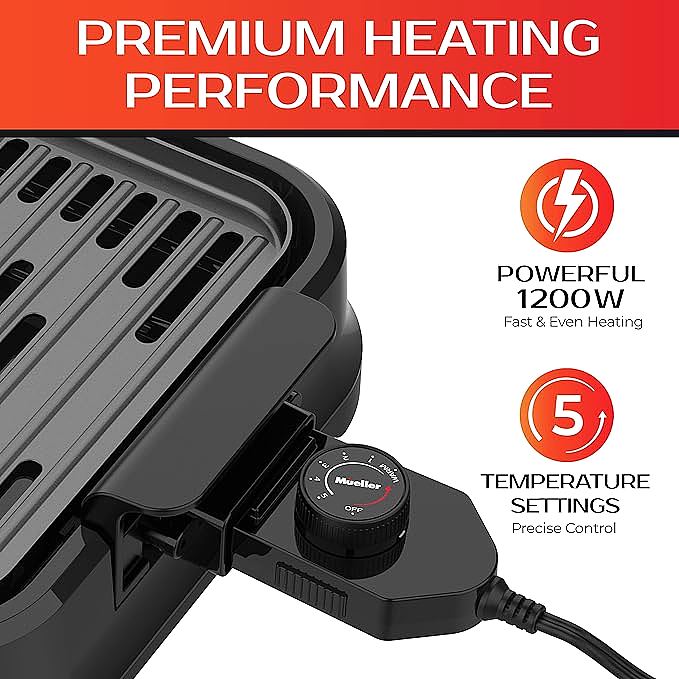
The skepticism regarding electric grilling usually stems from a lack of “btu” (British Thermal Unit) brute force. However, raw power is meaningless without efficient transfer. The Mueller Ultra Gourmet utilizes a 1200-watt heating element directly embedded or closely coupled with the grilling surface. Unlike a gas grill where a significant portion of heat escapes around the sides of the grate due to convection currents, an electric contact grill operates on principles of conductive heat transfer. This article dissects the machinery of this countertop device, moving beyond the marketing fluff of “delicious food” to understand the physics that allows a $45 appliance to sear a steak without triggering the fire alarm.
The Physics of Resistive Heating and Thermal Mass
Joule Heating: The Engine Room
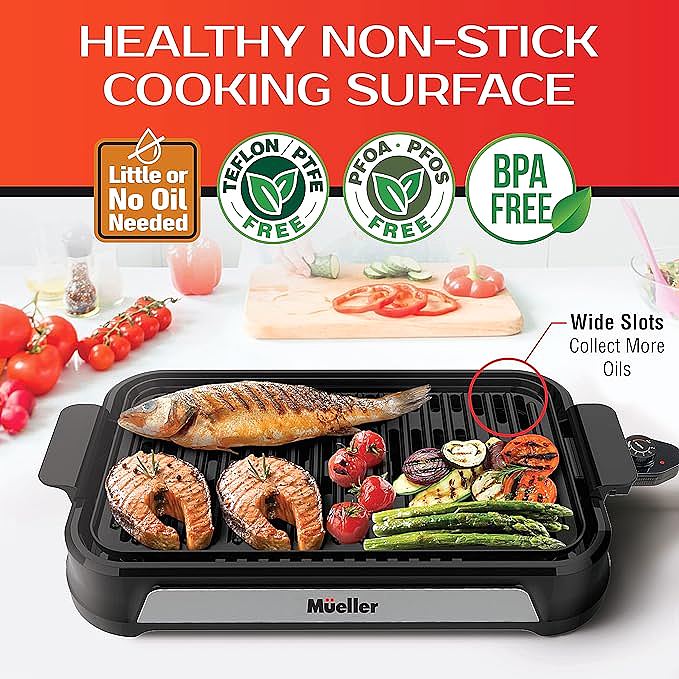
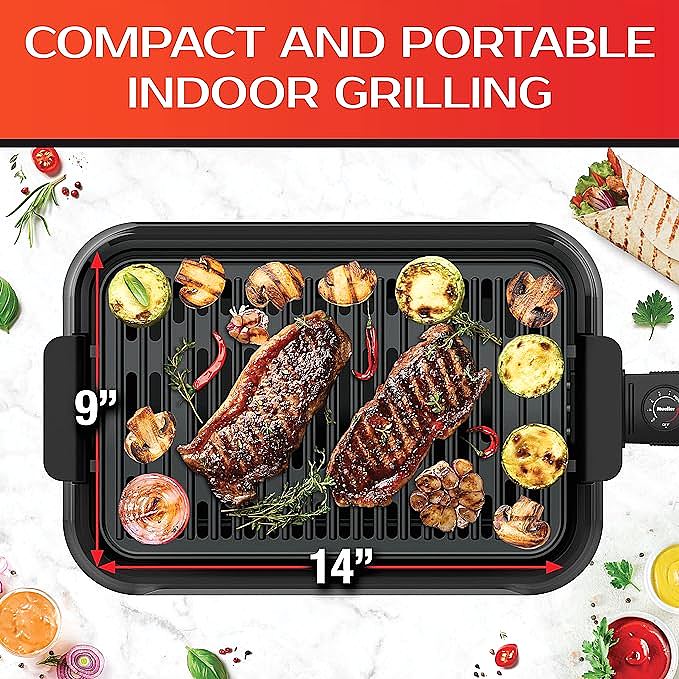
At the heart of the Mueller Ultra Gourmet lies a resistive heating element converting 1200 watts of electrical energy directly into thermal energy. This process, known as Joule heating, occurs when an electric current passes through a conductor with high resistance. The electrons collide with the atomic lattice of the conductor, transferring kinetic energy that manifests as heat. In the context of grilling, the efficiency of this conversion is paramount. A 1200-watt element (1.2 kW) is substantial for the surface area provided (approx. 13” x 19”). This power density is critical because the primary challenge in grilling is not reaching a high temperature, but maintaining it when a cold thermal mass—like a 16oz ribeye steak—is placed on the surface.
When a cold protein hits a hot surface, the immediate vicinity of the grill plate undergoes a rapid temperature drop. If the heating element lacks the wattage to recover quickly, the meat sits in a lukewarm limbo, releasing moisture and stewing in its own juices rather than searing. The Mueller’s specific wattage-to-surface-area ratio is engineered to minimize this recovery time. By sustaining temperatures up to 430°F (221°C), the unit ensures that the surface remains hot enough to drive off surface moisture instantly. This rapid evaporation is the prerequisite for the Maillard reaction, which cannot begin in earnest until water—which boils at a mere 212°F (100°C)—is removed from the equation.
Dry Heat vs. Wet Heat
One distinct advantage of electric resistance heating over propane is the nature of the heat itself. Propane combustion produces water vapor as a chemical byproduct. For every molecule of propane burned, four molecules of water are produced. In a confined gas grill, this creates a humid environment that can inhibit the formation of a crisp crust. Electric heat is “dry” heat. There is no combustion byproduct adding humidity to the cooking microclimate. This dryness is a subtle but significant factor in how the Mueller grill achieves those distinct grill marks reported by users. The raised ridges of the grill plate act as conductive highways, delivering intense, dry heat to specific contact points on the food, while the valleys allow for airflow, preventing the trapping of steam that would soften the texture.
The Thermodynamics of Smoke Suppression
The Smoke Point Threshold
The marketing term “smokeless” is scientifically absolute, but in practice, it is relative. Smoke in cooking is primarily caused by particulate matter released when fats degrade under heat (reaching their smoke point) or when fats combust. The Mueller grill employs a passive thermodynamic separation strategy to mitigate this. The design features a grated cooking surface that allows rendered fats to drip away from the heat source immediately. This is a crucial distinction from a flat griddle, where fats would pool around the food and continue to heat up until they smoke.
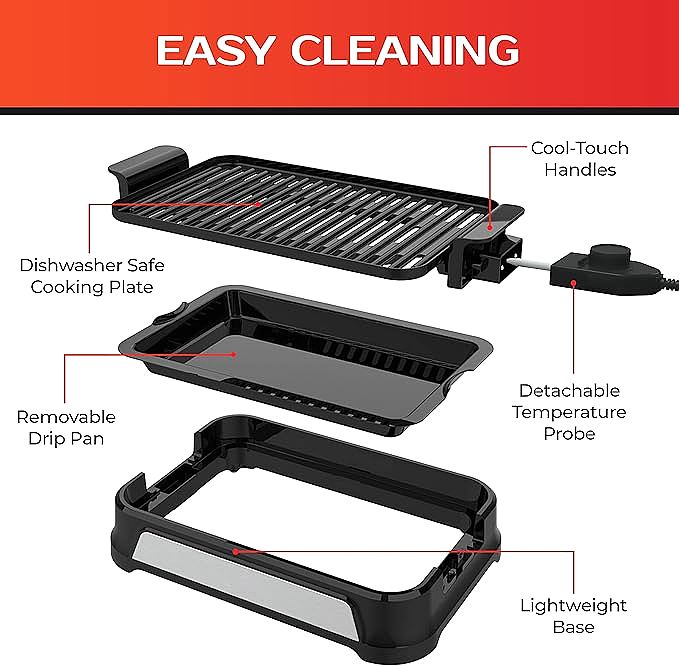
By utilizing gravity, the liquefied lipids are removed from the 430°F heat zone before they can chemically break down into acrolein and other smoke-producing compounds. The fat travels through the grates and lands in the drip tray below. This introduces the second component of the system: the water heat sink.
The Water Tray as a Heat Sink
The instruction to add water to the bottom drip tray is not arbitrary; it is a calculation based on the specific heat capacity of water. Water has a very high specific heat capacity (4.18 J/g°C), meaning it can absorb a large amount of energy without a significant rise in temperature. When hot grease at 350°F+ hits the water in the tray, the thermal energy is rapidly dissipated into the water volume. The grease is instantly cooled below its smoke point, solidifying or floating harmlessly on the surface.
Without water, the metal drip tray would eventually heat up via radiation from the element above. If the tray reached 300-400°F, the dripping fat would hit the hot metal and smoke instantly, defeating the purpose of the design. The water acts as a thermal buffer, clamping the temperature of the collection zone well below the threshold of smoke generation. Furthermore, the water surface acts as a trap for any aerosolized oil particles that might otherwise become airborne, physically capturing them before they can drift into the room.
Surface Chemistry and Material Engineering
Fluoropolymer Interaction
The cooking surface of the Mueller Ultra Gourmet employs a nonstick coating, typically a fluoropolymer based on PTFE (polytetrafluoroethylene). The physics of nonstick surfaces are governed by surface energy. PTFE has an extremely low surface energy, which creates a high contact angle for liquids (both water and oil). This means that instead of spreading out and bonding with the surface asperities of the metal, food proteins and starches “bead up” and sit on top.
This low coefficient of friction (often less than 0.1, comparable to ice on ice) is what allows for the “dietary” benefit mentioned in the product literature. In a traditional cast iron or stainless steel pan, oil is required to fill the microscopic voids in the metal to prevent mechanical bonding (sticking). With the fluoropolymer coating, this barrier is inherent to the material. This allows the user to grill delicate items like fish—which has a protein structure that is notoriously prone to tearing—without the structural failure that occurs when the meat adheres to the grate.
However, the thermal conductivity of the underlying metal—likely cast aluminum—is what drives the performance. Aluminum is an excellent conductor of heat (approx. 237 W/m·K), ensuring that the heat generated by the resistive element is spread evenly across the 13x19 inch surface. If steel (approx. 50 W/m·K) were used without a conductive core, the grill would have severe hot spots directly over the element and cold spots elsewhere. The combination of a highly conductive substrate with a low-surface-energy coating is the standard for modern high-performance cookware.
The Limitations of the “Smokeless” Promise
It is vital to address the “Smokeless” claim with scientific honesty. While the water tray mechanism eliminates smoke from drippings, it cannot eliminate smoke from the food itself if the cooking temperature exceeds the smoke point of the oil or rub used on the meat. If a user covers a steak in extra virgin olive oil (smoke point ~375°F) and cranks the Mueller grill to 430°F, the oil on the surface of the meat will smoke, regardless of the drip tray below. True smokelessness is a function of both the hardware capability and the user’s understanding of oil chemistry. The hardware manages the waste; the user must manage the active cooking surface.