The 'Social Grill' Diagnosis: Deconstructing the 1500W Power-Sharing Compromise
Update on Nov. 13, 2025, 7:48 a.m.
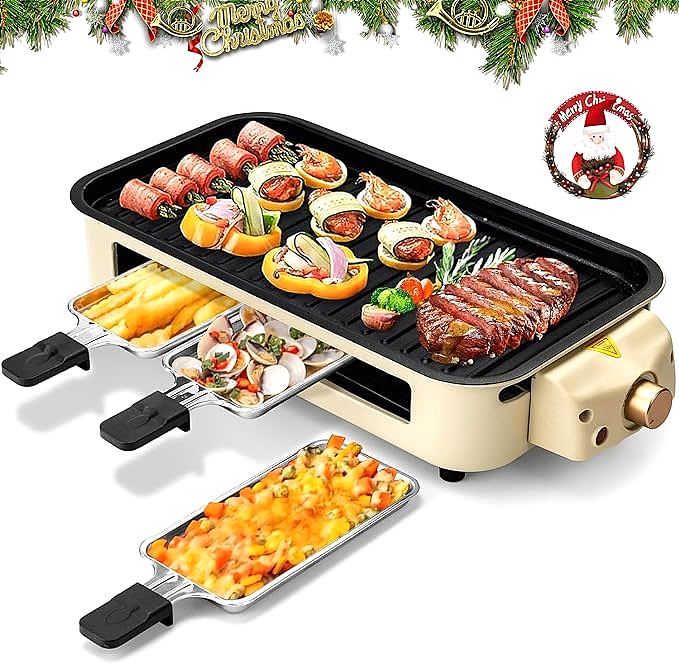
The “raclette grill” is less an appliance and more a concept. It is the promise of a “portable social restaurant” (as the manufacturer states), an invitation for guests to gather around the table and participate in the meal.
However, this social promise is built on a “first principles” engineering trade-off that is critical to understand.
When users receive a 1500-watt appliance like the CUSIMAX CMRG-300, they often expect high-speed, searing performance. This is immediately contradicted by real-world experience. As user “spykeninjafire” notes, “The grill doesn’t heat up very fast… Takes a while to get a good sear on meats.”
This “slowness” is not a defect. It is the key to the product’s entire “social” design.

The 1500W “Power-Sharing” Compromise
A 1500-watt heating element sounds powerful. But unlike a 1500W contact grill (which traps heat), a raclette grill is an open-air system that must power two distinct cooking zones simultaneously:
1. The 19x9” Top Plate: (The Grill/Griddle)
2. The Bottom Deck: (Heating the 8 Raclette Pans)
That 1500W of power must be split between these two zones. It is not, and cannot be, a high-performance “searing” machine.
The “Hollow Center” Diagnosis
This “power-sharing” compromise is further revealed by a critical user diagnosis from “Steven S.”:
”…the center of the pans do not cook well. You end up having to turn the pans at an awkward angle…”
This is a brilliant “first principles” observation. It strongly implies the 1500W heating element is not a uniform grid. Instead, it is most likely a ring or U-shaped element that runs along the perimeter of the appliance.
This design is a logical engineering choice:
* It radiates heat down onto the outer edges of the 8 pans below.
* It radiates heat up to the entire 19x9” grill plate above.
The “cold spot” in the center of the bottom deck (as “Steven S.” found) is the void where the element is not. This is a deliberate compromise to heat both levels with one element.

The Real User Manual (The “Scott Larson” Method)
This engineering reality (slow, uneven heat) is what creates the “social” experience. This is not a tool for “speed”; it is a tool for “time.”
The 5-star review from “Scott Larson” should be the real user manual. He warns you:
“If you buy it thinking you’re going to do 1” thick full-size steaks at the table you’re going to be disappointed.”
His advice?
“Try stir-fry size pieces though and you’ll be pleased.”
This is the key. The machine is not designed for a “1-inch steak.” It is designed for small, bite-size pieces of steak, chicken, and vegetables that can be cooked through by the “slow” 1500W heat.
This slowness is a feature, not a bug. It forces you to wait. As “Scott Larson” concludes, “While grilling, conversation flows. Everyone willingly gathers around the dinner table to grill, tell stories, and eat… instead of grabbing something and retiring to different corners of the house.”
The Final Diagnosis
The CUSIMAX CMRG-300 is not a “high-performance” grill. It is a “high-experience” social tool.
Its 1500W of power is a compromise, designed to simultaneously (and slowly) grill thin-cut foods on top while gently (and unevenly) melting cheese in the pans below.
The “flaw” (slow heat) is, in fact, the point. It is an appliance engineered for conversation, not speed.