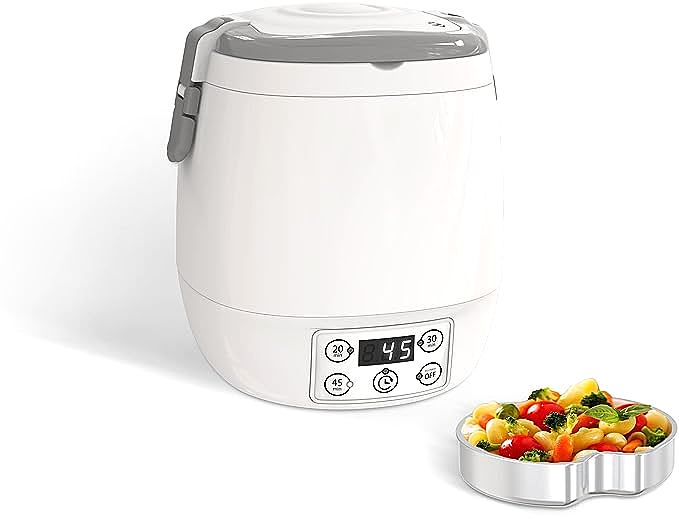
CHACEEF CFXB-YM20Y: Your Compact Kitchen Companion for Perfect Rice Every Time
Update on Sept. 16, 2025, 3:19 p.m.
For a staple food consumed by billions, rice can be surprisingly temperamental. A single misstep—too much water, too little heat, a moment’s inattention—can turn a potential fluffy delight into a soggy mess or a burnt offering. The challenge lies in a process that is both simple and scientifically complex: transforming hard, opaque grains into tender, translucent morsels.
This is where the humble rice cooker enters the picture. It’s an appliance so common, its operation seems almost magical. We add rice and water, press a button, and return later to find a flawless result. But there is no magic here—only elegant engineering and a mastery of fundamental physical and chemical principles.
Let’s pull back the curtain on the science of the CHACEEF CFXB-YM20Y Mini Rice Cooker, a compact marvel that serves as a perfect case study for how sophisticated science can be distilled into a simple, everyday object.

The Culinary Chemistry of Starch
At the heart of every pot of rice is starch gelatinization. A raw grain of rice is a tightly packed matrix of starch granules, specifically the polymers amylose and amylopectin. These granules are crystalline and rigid, which is why raw rice is inedible. The transformation begins when these granules are immersed in water and heated. As the temperature rises, the starch begins to absorb water, causing the granules to swell and soften.
This hydration process accelerates dramatically as the temperature approaches the boiling point of water ($100^{\circ}C$ or $212^{\circ}F$). At this point, the crystalline structure of the starch breaks down, and the molecules uncoil, dispersing into the surrounding water. This is the moment of gelatinization, which gives cooked rice its soft, pliable texture. A rice cooker’s primary mission is to ensure this process occurs evenly and completely, and that’s where the technology comes in.

A History of Heat: From Simple Plate to Smart Tech
The journey of the modern rice cooker is a story of improving heat transfer. The earliest models used a simple heating element, often resulting in uneven cooking and scorched rice at the bottom. The bottom plate heating method, which the CHACEEF CFXB-YM20Y employs, was a significant leap forward. This design places a broader, more efficient heating element directly beneath the inner pot, ensuring a consistent and uniform thermal distribution.
This method strikes a perfect balance. While more advanced rice cookers utilize Induction Heating (IH)—which heats the entire pot via an electromagnetic field for even greater precision—bottom plate heating remains the reliable and cost-effective standard. It provides a level of consistency far superior to traditional stovetop methods, all while maintaining a price point accessible for students and small households.

An Engineered Solution for Modern Living
The CHACEEF CFXB-YM20Y is a testament to the principle that big things can indeed come in small packages. Its compact size and thoughtful features are not just design choices; they are a series of elegant engineering solutions tailored for today’s lifestyle.
The Physics of Portability and Power
Measuring just 7.6 inches in height and weighing only 3.5 pounds, this mini cooker is a perfect fit for a dorm room desk, a tiny apartment counter, or an RV kitchen. Its low 200-watt power rating is a key part of this design. It consumes minimal electricity, making it ideal for spaces with power limitations, and its low wattage is perfectly matched to its small heating element, ensuring efficient cooking without wasting energy. It’s a prime example of engineering that optimizes power for a specific task, proving that you don’t need a high-wattage appliance to achieve outstanding results.
The Clever Automation of One-Touch Control
The simplicity of the CHACEEF’s one-touch control panel—just “COOK” and “WARM”—hides a brilliant bit of automation. This is not a complex microchip but a classic application of a thermal sensor, most likely a bimetallic strip. This component, made of two different metals bonded together, bends as it heats up. As the rice cooks, the water boils and then evaporates. When all the water is absorbed, the temperature inside the pot quickly rises above the boiling point. The bimetallic strip, sensing this temperature spike, bends to break the circuit for the heating element, automatically switching the cooker to the low-temperature “WARM” setting. This simple, fail-safe mechanism prevents burning and keeps the rice at an ideal serving temperature until you’re ready to eat.
The Material Science of a Healthy Pot
The inner pot’s non-stick coating is another critical component. Beyond making cleanup a breeze, the material science here is a direct response to consumer health concerns. The pot is certified BPA, PFAS, and PFOA-Free. PFOA and PFAS are a group of “forever chemicals” that have been phased out due to their persistence in the environment and potential health risks. By using a safer, food-grade non-stick material, the CHACEEF CFXB-YM20Y ensures that your food remains pure and safe from harmful contaminants. This design choice reflects a commitment to modern health standards and material safety.

Beyond the Grain: A Versatile Workhorse
While it excels at cooking perfect white rice, the CHACEEF’s core technology makes it remarkably versatile. Its ability to maintain a consistent heat can be leveraged to prepare everything from creamy oatmeal and savory porridge to hearty soups and stews. For a busy professional or student, this multi-functionality transforms it from a single-purpose gadget into a mini-kitchen powerhouse. It’s a tool that adapts to your needs, all by simply adjusting the ingredients and liquid ratios, trusting the cooker to apply the heat consistently.

The CHACEEF CFXB-YM20Y Mini Rice Cooker is more than just a kitchen appliance; it’s a small-scale triumph of engineering. It distills centuries of culinary knowledge and a deep understanding of physics and chemistry into a compact, elegant, and effortlessly user-friendly device. It doesn’t just make cooking rice easy; it makes the science behind it transparent, proving that even the simplest everyday objects can hold a world of wonder.