The Thermodynamics of the Grain: Engineering the Perfect Solo Meal
Update on Jan. 9, 2026, 10:39 a.m.
In the vast lexicon of culinary history, rice holds a position of singular importance. It is the sustenance of billions, a grain that has shaped civilizations. Yet, for the modern urban dweller, the act of cooking rice has undergone a profound transformation. Gone are the days of communal hearths and massive cauldrons feeding extended families. Today, the kitchen is often a solitary sanctuary, and the culinary challenge has shifted from volume to precision.
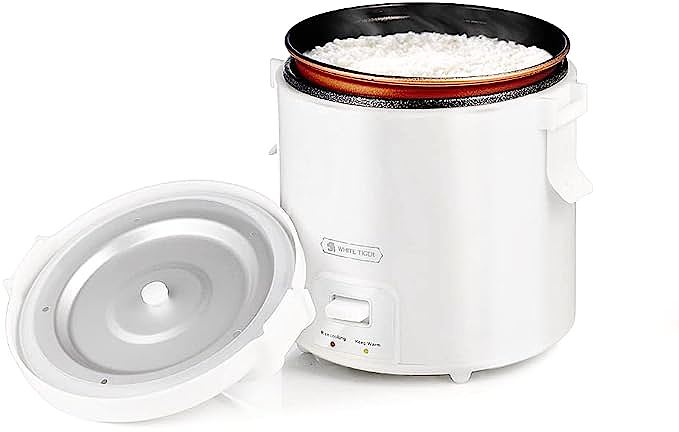
This shift has given rise to a specific class of appliance: the mini rice cooker. But to dismiss these devices as mere toys or scaled-down novelties is to misunderstand the physics of cooking. The OCTAVO 2 Cup Rice Cooker represents a convergence of thermal engineering and material science designed specifically for the micro-batch.
Why does rice cooked in a massive pot often fail when prepared in small quantities? Why are we seeing a mass migration from traditional non-stick surfaces to ceramics? This article delves into the invisible forces—thermodynamics, starch chemistry, and surface tension—that govern the perfect bowl of rice, exploring how compact engineering is rewriting the rules of the solo meal.
Part I: The Thermodynamics of Small-Batch Cooking
The primary challenge in cooking a small amount of rice—say, one or two cups—in a standard-sized cooker is a matter of thermal inefficiency and moisture loss. It is a problem of geometry.
The Surface-Area-to-Volume Ratio
In physics, the Surface-Area-to-Volume Ratio (SA:V) is a critical factor in heat transfer and evaporation. A large 10-cup pot has a vast bottom surface area and a large headspace. If you attempt to cook just one cup of rice in it, the water spreads out into a thin, shallow layer.
This shallow depth creates two problems:
1. Rapid Evaporation: The large surface area exposes a significant percentage of the water to the air (or headspace) above it. Water evaporates faster than the rice grains can absorb it. The result is often undercooked, hard rice, or rice that is cooked unevenly—dry on top and burnt on the bottom.
2. Inefficient Convection: Rice cooks best when the grains can dance. As the water boils, thermal convection currents circulate the grains, ensuring even heat distribution. In a shallow layer, there is no vertical room for these currents to form. The grains sit statically, leading to uneven gelatinization.
The Micro-Environment Solution
A dedicated mini rice cooker, like the OCTAVO, solves this by reshaping the cooking vessel. By narrowing the diameter of the pot, it forces the water and rice into a deeper column rather than a shallow puddle. This restores the vertical depth necessary for convection currents to churn the grains effectively.
Furthermore, the reduced headspace limits the volume of air that needs to be saturated with steam before pressure builds. This creates a tighter, more thermally stable environment. The steam pressure equilibrates faster, penetrating the husk of the brown or white rice grain more efficiently. This is why a purpose-built 1-liter cooker will almost always outperform a 5-liter cooker doing the same small task; it is thermodynamically optimized for the specific mass of the ingredients.

Part II: Material Science: The Ceramic Renaissance
For decades, the standard for non-stick cookware was Polytetrafluoroethylene (PTFE), commonly known as Teflon. While effective, PTFE has faced increasing scrutiny regarding its thermal stability and potential health risks when overheated (releasing fumes) or when the coating degrades over time. This has driven a materials revolution in the kitchen, leading to the rise of ceramic non-stick coatings.
The Sol-Gel Process
The “ceramic” coating found in modern appliances is not a solid piece of pottery glued to metal. It is typically created through a sophisticated chemical process called Sol-Gel (Solution-Gelation).
1. Sol: A solution of inorganic minerals (often silicon-based, derived from sand) is prepared.
2. Gel: This solution undergoes a chemical reaction to form a gel-like network.
3. Curing: The gel is applied to the metal substrate (the inner pot) and fired at high temperatures. This drives off the liquid and fuses the minerals into a hard, glass-like ceramic layer.
Thermal Conductivity and Safety
The advantages of this ceramic layer extend beyond safety. While PTFE is a thermal insulator (it resists heat transfer), ceramic materials are generally better thermal conductors. This allows the heat from the rice cooker’s heating plate to transfer more rapidly and evenly through the pot wall and into the water.
This rapid transfer is crucial for the “boil” phase of rice cooking, where a vigorous rolling boil is needed to agitate the grains. Additionally, the OCTAVO model emphasizes a BPA-free construction and a non-toxic ceramic liner. This appeals to the health-conscious consumer who wants to minimize the intake of synthetic fluoropolymers. The ceramic surface is also inherently harder and more scratch-resistant than traditional soft PTFE coatings, offering a longer service life if treated with care (avoiding metal utensils).
From an operational standpoint, the ceramic surface possesses low surface energy, meaning water and starch molecules struggle to bond to it. This provides the “easy release” property that makes cleaning sticky rice residue a simple rinse rather than a scrubbing match.

Part III: The Biochemistry of the Perfect Grain
Cooking rice is not simply “adding hot water.” It is a complex biochemical process involving the transformation of starch. Rice grains are composed primarily of two types of starch molecules: amylose (linear chains) and amylopectin (branched chains).
The Gelatinization Curve
The goal of the rice cooker is to manage Starch Gelatinization.
1. Absorption (Soaking): At lower temperatures, water enters the amorphous regions of the starch granule. The granule swells slightly but remains intact.
2. Swelling (Boiling): As temperature rises (above 60-70°C), the crystalline structure of the starch begins to melt. The granules absorb massive amounts of water and swell irreversibly. Amylose leaches out into the surrounding water.
3. Retrogradation (Cooling): If cooled too quickly or stored improperly, the starch molecules recrystallize, making the rice hard (stale).
Algorithmic Cooking
A simple pot on a stove requires the cook to manually manage the heat to navigate these stages: high heat to boil, low heat to simmer, off heat to steam. A digital rice cooker like the OCTAVO automates this via a pre-programmed algorithm (often using “Fuzzy Logic” in higher-end models, or precise thermostatic control in compact ones).
The “5-in-1” preset functions are essentially different temperature-time profiles. * White Rice Profile: A standard ramp-up to boil, a sustained boil to ensure gelatinization, and a steam phase to allow excess moisture to reabsorb. * Brown Rice Profile: Brown rice is encapsulated in a tough bran layer. The algorithm typically includes a “pre-soak” phase at a warm temperature to soften the bran before the boiling begins. Without this, water cannot penetrate the starch center efficiently, leading to crunchy grains. * Porridge Profile: This maintains a temperature just below the vigorous boil for a longer duration. The goal is to break down the granule structure completely, allowing the amylose to form a thick, viscous gel (the creamy texture of porridge) without boiling over.
This algorithmic precision ensures that whether you are cooking a single cup of delicate Jasmine rice or a hearty bowl of steel-cut oats, the device applies the correct thermodynamic curve for that specific biochemical structure.

Part IV: Designing for the Micro-Environment
The engineering of a mini rice cooker also involves solving the specific problems of the “Micro-Environment”—the constrained space of a dorm room, an office desk, or a small apartment kitchen.
Thermal Isolation and Safety
In a full-sized kitchen, a hot pot is moved to a trivet. In a dorm or office, you might not have a trivet, or even a proper table. This necessitates a higher degree of integrated safety. The OCTAVO features an integrated anti-scald handle directly on the inner pot. This is a clever piece of ergonomic engineering.
Typically, the inner pot is the hottest component. By creating a thermal break between the ceramic pot and the handle material, the design allows the user to lift the boiling hot vessel immediately after cooking without oven mitts. This “mug-like” usability transforms the inner pot into a serving vessel, eliminating the need for an extra bowl—a crucial feature when living space and dishware are limited.
The Psychology of the Delay Timer
The inclusion of an 8-hour delay timer in a compact device speaks to the sociology of its user. The target demographic—students, busy professionals—often operates on tight, disjointed schedules.
From a food safety perspective, leaving raw rice and water at room temperature is generally safe for a few hours (unlike meat). The timer allows the user to decouple the act of preparation from the act of consumption. You prep the machine at 8:00 AM, and the machine calculates backwards to ensure the cooking cycle finishes exactly at 6:00 PM. This temporal shifting is a key value proposition of modern smart appliances. It provides the psychological comfort of knowing a hot meal is waiting, reducing the cognitive load of “what’s for dinner” after a long day.
Conclusion: The Science of Sufficiency
The mini rice cooker is a testament to the idea that “less is more.” By reducing the volume of the cooking vessel, we gain thermodynamic efficiency for small portions. By simplifying the interface to five core functions, we cover 90% of the daily carbohydrate needs for the average person. By upgrading materials to modern ceramics, we gain health benefits and durability.
The OCTAVO 2 Cup Rice Cooker is not trying to feed a banquet; it is trying to feed you. In doing so, it respects the physics of small quantities and the biological reality of individual nutrition. It proves that the sophisticated principles of heat transfer and biochemistry are just as relevant in a 1-liter pot as they are in an industrial kitchen. For the solo diner, it transforms the chore of cooking into a precise, reliable, and scientifically sound ritual.